


A decade ago The Economist was running an on-line vocabulary test, and by 2013 over 2 million people had taken it, with fascinating results. Are you aware, that as an adult native speaker of English, you know between 20,000 and 35,000 words? Eight year olds were found to know on average 10,000 words, and 4 year olds around 5,000.1
There is a big difference between a person’s ‘passive’ or ‘receptive’ vocabulary, words they recognise and understand, and their ‘active’ or ‘expressive’ one, the words they actually use. Typically children aged between two and three actively use around 200 words or phrases, although some may use as many as 1000.
An extensive vocabulary is the best gift you can give children. It’s all very well becoming a proficient reader, but if you’ve no idea what the words you’re reading mean, you are not literate. An amazing and depressing statistic is that 9 million people in the UK are functionally illiterate.2 And even though there’s a lot of attention given to supporting children’s language development, early years teachers are now struck when they hear a two-year old articulating her ideas fluently. But this should be the norm, not the exception, and our expectation of children’s language proficiency has definitely dropped in recent years.
A major factor in this decline is that modern children are surrounded by devices emitting a non-stop barrage of spoken words, and frequently they’re exposed to more than one source at a time. This blurs their perception of the individual words and just turns them into undifferentiated noise. From infancy children need to hear real language spoken in real time, in real life and in a real context, by one real person to another, or by a group of people engaged in real and meaningful conversation. It seems that children may need to hear a new word around 20 times before it becomes part of their working vocabulary. Adults’ preoccupation with their own communication on their various devices can reduce the amount of time they spend engaging naturally in conversation with their own children, making it more difficult for the children to absorb words and to become proficient speakers of their own language.
Reading books to children is widely recognised as a key tool in building vocabulary, but research has found that children learn new words more effectively from a story that is read repeatedly than from when they occur in a variety of different stories.3 This is something children instinctively know – what parent hasn’t thought, ‘Oh please, not that story again!’? But by reading that same old story yet again we are strengthening our children’s vocabulary and building their language skills. And if we can make a conscious effort to use those new words with the children they’ll become part of their active vocabulary.
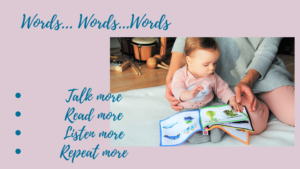
And here’s a challenge going forward… can you teach your child 15 new words a week and practise them regularly? Over 4 weeks that would be 60 new words added to their vocabulary. And over a school year? Nearly 600. And these will be in addition to the ones they will be picking up anyway!
- https://www.economist.com/johnson/2013/05/29/lexical-facts
- https://www.theguardian.com/education/2019/mar/03/literacy-white-working-class-boys-h-is-for-harry
- https://www.frontiersin.org/articles/10.3389/fpsyg.2013.00149/full