
Food Rules OK!

Food is a basic human need, and the life of our humanoid ancestors was entirely focused on hunting and gathering enough to eat, and relaxing and resting once their hunger was satisfied. But now, even though we don’t spend our whole lives looking for food and can just get it from the shop, it is now commercially exploited to the point that it can become a fixation in a variety of ways.
TV shows and celebrity chefs tell us what to eat, how to prepare it, and how to savour it, while fitness gurus and dieticians encourage us to give up certain foods and follow specific diets and eating regimes intended to make us more healthy, more shapely and happier. Seasonality of produce has become irrelevant, particularly for city-dwellers, and the choice and quantity of food available all year round on supermarket shelves is huge, the amount we waste is huge also, but in spite of that, we are becoming huge ourselves – 40% of the UK population is overweight, with long term health issues lying in wait.
And all the time our children are being targeted as consumers of unhealthy but desirable ‘treats’, high in sugar, fat and salt, and becoming obese as a result. Feeding the family can often be a daily battle, because for many parents getting their children to eat is a constant worry and an on-going source of tension. Children sense this, and exploit the attention that centres on them not eating. The situation gets worse each time it’s repeated, and parents, increasingly stressed and frustrated, may resort to bribery, threats, entertainment or offering lots of food choices. The situation degenerates into a battle of wills, which the children win by manipulating it to get what they want, because parents are driven by instinct to do anything to get their child to eat.

If this sounds familiar, keep in mind that in all areas of life children need boundaries. It is down to the adults to put the rules in place and stick to them, and eating is no exception.
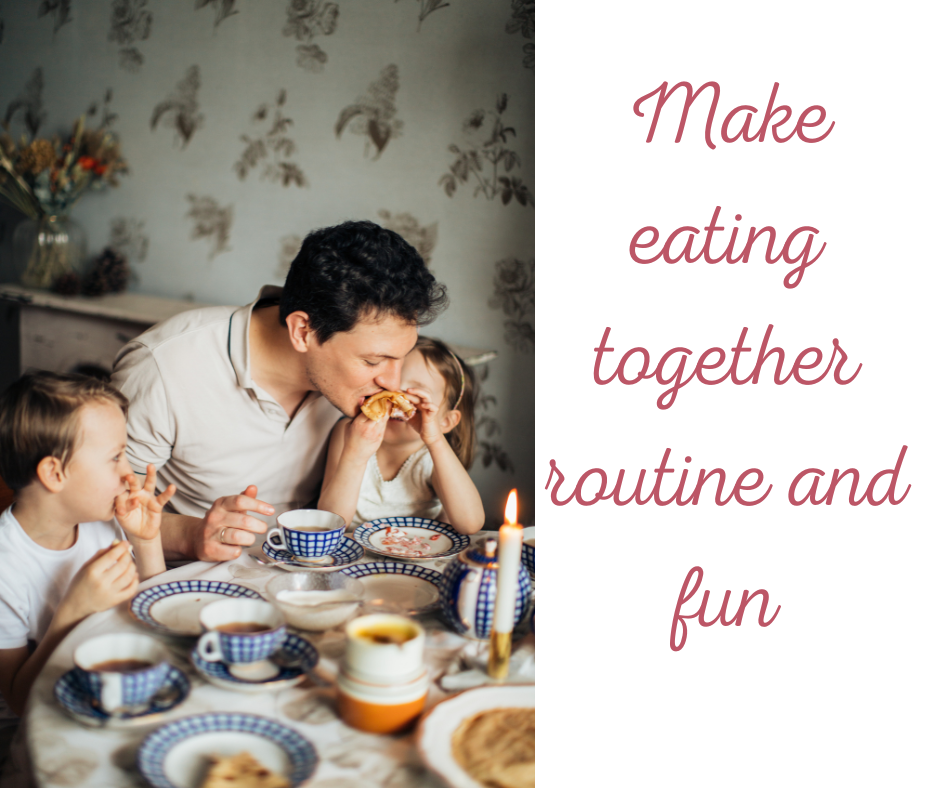
One good rule is to sit down together as a family to eat whenever possible, including even the youngest children. Like this, they learn the cultural and social conventions around eating; they hear the conversation going on at the table, which is so good for their language development and they learn how to play their part in this appropriately.
They also need to learn how to use crockery and cutlery. So many children arrive in nursery at around 3 unable to drink out of a glass or cup, because they’ve only ever been given a bottle or a sippy cup, and still unable to use a spoon, never mind a small knife and fork.
Even if a child is going to be eating alone, he should be encouraged to set, or help set his table, and then to sit down to eat, rather than being allowed to wander about, grazing as he goes. And eating on the sofa in front of the TV should be an occasional family treat rather than a solitary everyday occurrence.
Another good move is to adopt a limited menu approach. Choose what you know your child will eat, give her advance warning of what to expect and stick to your plan. You’re the chef in charge of the kitchen. Within the meal you can provide limited options. For example, if you’re having sausages and mash, you could offer a choice of peas or carrots, or both. But don’t be tempted to negotiate on the sausages: if she doesn’t want to eat the sausages there’s still the peas, the carrots and the mash. If you get into the habit of refusing to negotiate, she will realise this is a non-negotiable boundary and will fall in line. And you will be able to gradually extend the range of dishes on your menu that she will happily eat.

Take full control of the shopping! Before you go shopping with the children share your planned menu with them, and get them to help you compile the list of what you need. When you get to the supermarket, stick to your list. If you are constantly being asked to buy this and that, offering limited choice is a good strategy. Because you’ll need to be sure to respect what they choose, you’ll have to limit the options to what is suitable and affordable. Rather than giving a completely open-ended choice, better to be very specific and firm: ‘You can choose either one of these or one of those.’
It’s worth keeping in mind that when children are empowered to make food choices, they tend to choose what they know and like. This then progressively limits their diet, and makes them even less willing to try new textures and tastes.

Another suggestion is to make your fridge strictly off-limits to the children. Snacking at will between meals is not something to encourage because it can take the edge off their appetites, making them less ready for meals. It also interferes with your stock control, and any attempts you may be making to ensure they’re having a balanced diet. Running the fridge and accessing its contents are adult responsibilities. The fridge should be a no-go area for unsupervised access.

We all have an inbuilt mechanism for knowing when we’ve had enough to eat, something as adults we often choose consciously to ignore. So – we over-eat. But children, even very young ones, make it clear when they’ve had enough. They’re unconsciously in tune with their bodies in a way that adults may no longer be. As parents we’re inclined to encourage them to want to have a bit more, and sometimes they will have another mouthful or two, but it’s better for them, and less stressful for us, if we respect their ability to know when they’re full and recognise it as a positive aspect of their eating.

There’s a lot of official focus on healthy eating, and pressure on early years practitioners to promote this with small children. Since our food is highly regulated from the point of view of being safe to eat, and so from that point of view, healthy, we need to watch we’re not classing ice-cream, sweets, chocolate or chicken nuggets as ‘unhealthy’.
At Seedlings we focus on balance. We talk about what it’s good to eat lots of – grains, vegetables, protein, and what it’s good to have small quantities of now and then – cakes, biscuits, ice-cream. We learn about food groups, and what makes a balanced meal. You will be supporting us in this through what you put in your child’s lunchbox.
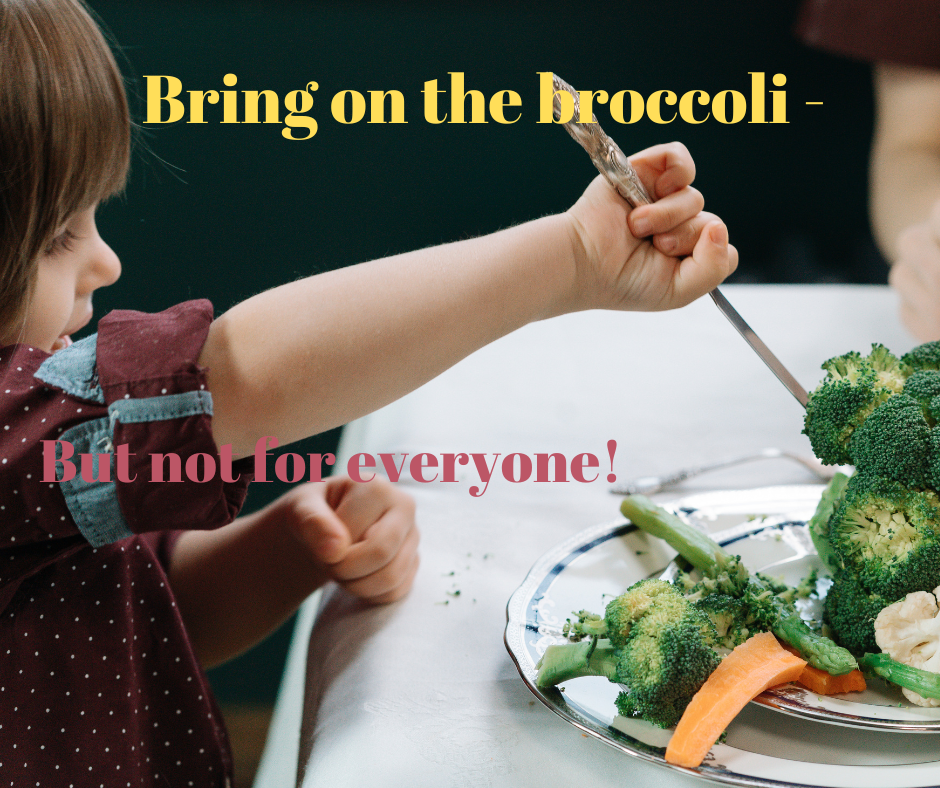
And one thing to keep in mind is that even though lots of leafy greens, specially broccoli and cabbage, feature in a balanced diet, research has found that chemicals strongly present in some children’s saliva are responsible for their aversion to these vegetables, so children who absolutely refuse to eat these are not just being picky eaters!